






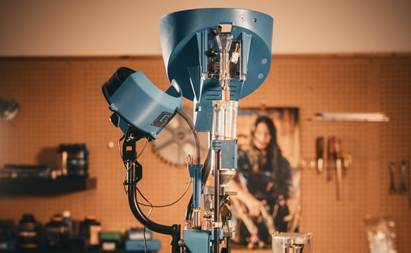
There’s always something new. Anyone who loads their own ammunition pays close attention to even the smallest details. Dillon recently introduced a new “Bullet Feeder”; until now, users had to rely on accessories from other manufacturers. That’s reason enough to take a closer look at it.
By Thorsten Schmitt and Arno Graner
The Scottsdale, Arizona-based company is considered a pioneer in reloading. Dillon Precision has been setting the standard with its reloading presses for decades. The company enjoys an excellent reputation among both professional shooters and hobbyists. Until now, however, there was no automated bullet feeder directly from Dillon Precision, so users had to make do with accessories from other manufacturers. Recently, the situation has changed, as Dillon Precision has now added a “Bullet Feeder” to its product line. We put the Bullet Feeder through its paces over an extended period (approximately 50,000 rounds in 9×19 and .40 S&W calibers).
How It Works
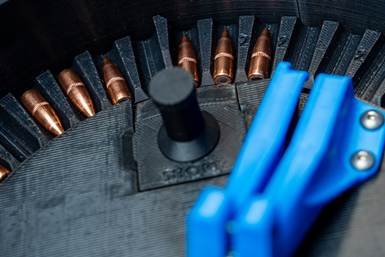
There are various methods for orienting or aligning bullets in the correct direction within a “bullet feeder.” One method involves rotating the bullets on a sorting disc. Dillon Precision has opted for a different approach. In this system, misaligned bullets are automatically sorted out by design and fall back into the feed hopper. Neither complex setup procedures nor tedious adjustments are necessary. In our long-term test, we tested not only various calibers but also different bullet shapes and weights; the result was always the same: perfect, trouble-free bullet alignment. The speed is continuously adjustable and can therefore be tailored to specific requirements. It should be noted here that even at “full throttle,” the feed rate is more than sufficient for a fully automated press.
Setup/What’s Included
When placing an order, you’ll need to select two factors. Naturally, you’ll need to choose the caliber; the options are: .22, .30, 9 mm, .40/10 mm, and .45. In addition, two different mounting brackets are available: one compatible with the Dillon 650/XL750 presses and another for the Super 1050/RL1100. A table-mount bracket is also available as an accessory, allowing the Bullet Feeder to be used with reloading presses from other manufacturers. Installation is very straightforward. After mounting the appropriate bracket, an angle-adjustable adapter is attached, onto which the Bullet Feeder is secured. The drive unit operates at 24 volts; the required 230-volt power supply [standard current in Europe] is included in the package. All that remains is to connect the bullet chute to the control unit—which is mounted directly on the bullet setting die—using a spring-loaded hose.
Bullet Feeder
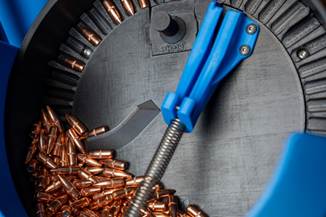
The motorized Bullet Feeder is compatible with all available calibers. It consists of a base unit with a drive motor, mounted on the appropriate bracket and adjustable for tilt. The base plate is made of steel, while the plastic components were manufactured using additive manufacturing processes. It is equipped with an on/off switch and a rotary control for the operating speed, which is continuously adjustable. The motor’s rotational motion is transmitted via a simple gear drive to the rotating hopper or the sorting disc. The drive is robust and, thanks to its dimensions, is fully capable of handling large quantities of bullets -according to the manufacturer, over 400 9 mm bullets – in the hopper without malfunctioning. The Bullet Feeder’s mount is also designed to minimize vibrations and oscillations as much as possible, even when the hopper is full. During our test run, 300–400 9 mm rounds were loaded. Only two adjustments need to be made. First, the angle, which is adjusted on the adapter between the mount and the base plate; second, the adjustment block inside the rotating part must be set to the respective round shape using a hand-knurled screw. The operation is simple and reliable.
Feeding
In our test series, not a single bullet was fed upside down. The adjustment is very easy to perform. Simply position the adjustment block all the way in and turn it out just enough so that the bullets reach the bullet ramp with their bases facing down. Bullets with their tips facing down fall back into the hopper. When correctly positioned, the bullets fall into the steel spring tube by gravity. Before the bullets reach the bullet-setting die, they pass through the control unit, which uses a spring-loaded contact to pause the Bullet Feeder when the supply is sufficient. Great emphasis was placed on functionality in the design of the bullet-setting die. It is made of high-quality steel and thus has a significantly higher weight than aluminum versions. Additionally, an internal spring support was incorporated. The combination of greater weight and spring tension ensures that unintended bullet feeding (an empty stroke without a case during setup or in the event of a press malfunction) does not occur. Here, too, reliability was proven during testing.
Caliber Change
Dillon offers a variety of caliber conversion kits. The conversion takes just a few minutes; all you need to do is replace all the parts included in the conversion kit. It goes without saying that a new initial setup must be performed once the conversion is complete. The conversion kits include pre-assembled parts, making the conversion quick and user-friendly.
Even though there are already various bullet feeders on the market, every manufacturer naturally tries to give its product that certain something in terms of functionality and reliability. In our test, the Dillon Precision Bullet Feeder impressed with consistently high operational reliability and a well-thought-out design. Setup is very quick and easy to accomplish; all necessary adjustments are almost self-explanatory. Once set up, the system operates consistently and reliably without any issues. Changing calibers is kept to a minimum thanks to the available conversion kits. The build quality is perfect, and setup is very straightforward. The value for money is impressive overall, and the long-term test—involving approximately 50,000 rounds in various calibers—proceeded without a single glitch.
This article was published by “Deutsches Waffen Journal”, a firearms magazine and Dillon Precision partner based in Germany.
